tiistai 17. elokuuta 2010

Moving charged particle experiences magnetic force

Right-hand rule is one way to remember the direction of magnetic force on charged particle. Current is in the direction of moving positive charge.
Hence, magnetic field exerts magnetic force on the rod carrying electric current.

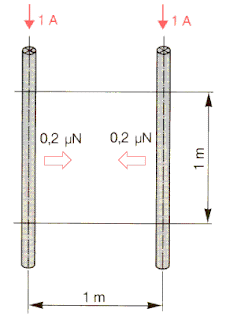
Definition of 1 A electric current is based on the magnetic force!
The force is perpendicular to both B-field and velocity (cross-product in the formula) and does not increase the speed but change the direction of velocity at any moment. The particle begins to undergo circular path. Try how the different variables affect to the Larmor radius.

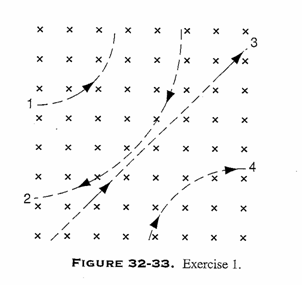
Can you conclude anything about the charges and masses of the four particles in the graph below?
sunnuntai 15. elokuuta 2010

Magnetic field

Permanent magnets (bar) or electric magnets (straight wire, solenoid,...) create magnetic field. Moving electric charge (current) gives rise to magnetic field. Unlike electric field lines, the magnetic field lines are closed loops i.e. no magnetic monopole exists. There are always both South pole and North pole.


The magnetic field at any point:
  • direction tangential to field line and towards South pole (outside the magnet)

  • strength proportional to density of field lines (also called magnetic flux)

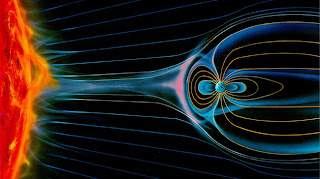
The geomagnetic field due to plasma streams (volcanic electric currents) inside the Earth and the field geometry pretty similar to the field of gigantic bar magnet. The separation between geomagnetic south and geographic north is about 11 degrees. Solar plasma flow (solar wind) reshapes the dipole field:


In the presence of many fields, the total field is a vector sum of the component fields.

maanantai 24. toukokuuta 2010

Electric current

The electric current is carried by moving electric charges (free electrons in metals) driven by external electric field (potential difference). The strength of the current depends on
  • Number of free electrons in bulk motion
  • Speed of the bulk motion (typically some cms in an hour)
  • Collisions between the atoms in thermal motion

Due to the collisions, electrons loose kinetic energy i.e. electrical energy is transformed thermal energy (power dissipation). To maintain the current, work needs to be done at the same rate inside the power supply (cell, battery etc).

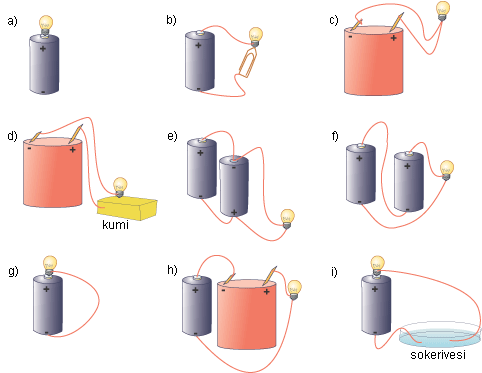
The lamp illuminates in five of the following cases. Which?


perjantai 23. huhtikuuta 2010

Electric potential and equipotential surfaces

Positive test charge in the electric field experiences electric force. Moving against the E-field means that work need be done against the force. The work equals to the increase of electric potential energy of the test charge.


As potential energy describes work done to place the charge in the field, the electric potential describes the field itself. For a radial field of spherical charge (no E-field inside the sphere):


  • Equipotential surfaces analogous to height contours in the gravity field. Perpendicular to electric field at any point
  • No work need to be done in moving a charge along the surface (no displacement in the direction of E-field)
  • Potential decreases in the direction of electric field
  • Potential is zero infinitely far away from the source of radial field and at any earthed point.

Consider homogenous E-field between two parallel plates separated by distance d. What is the work done in moving charge Q over the potential difference V? If the bottom of the thundercloud and the Earth surface made up the plate pair separated by 1500 m, what would be the potential difference if the electric field was measured to be 25 kN/C.

sunnuntai 18. huhtikuuta 2010

Electric Field and Coulomb

Stationary electric charge creates static electric field (like mass creates gravitational field).

The geometry of the field depends on the geometry and charge distribution (point, (-s), sphere, line, plate, dipole...)

E-field is described by field lines (here point charges):

  • At any point the direction of E-field is a) tangential to field line b) equal to the direction of electric force experienced by a tiny positive test charge.

  • Strenth of the field corresponds to the density of field lines.

Coulomb law gives the strength of electric force between two point or spherical charges. Try here if the force obeys Coulomb law.

keskiviikko 14. huhtikuuta 2010

Electric charge

Any charge (for us..) is a multiple of an elementary charge (-e for electron, +e for proton).

Two ways to create electric charge:

  1. Charging by friction. In contact, some atoms (materials) give away an electron more easily than others. Try brushing a sweater by a balloon.
  2. Charging by induction. What happens if you move the balloon close to the wall?


Earthing means connection to infinite source/sink of free electrons.
There is eather attraction or repulsion between two electric cahrges. Can you state the signs of the unknown charges?

torstai 18. maaliskuuta 2010

Malus and Brewster

In EM-wave, E-field oscillates perpendicular to the propagation.

  • Unpolarized wave: E-field oscillates in all possible directions on the plane

  • Polarized wave: E-field oscillates along a line (aka linearly or plane polarized)

Polarizer transmits the the component of E-field parallel to its transmission axis. And cuts 50 % of the intensity of unpolarized light.


Malus law: Set the transmission axes of the first and the third polarizers perpendicular to each other. How would you orientate the middle polarizer to have maximum intensity received in the detector? Can you proof it theoretically?

Brewster law: Reflected light is completely polarized if there a right angle between reflected and refracted components. Otherwise it is partially polarized. Rotate the View Angle and take a look to the two components.